
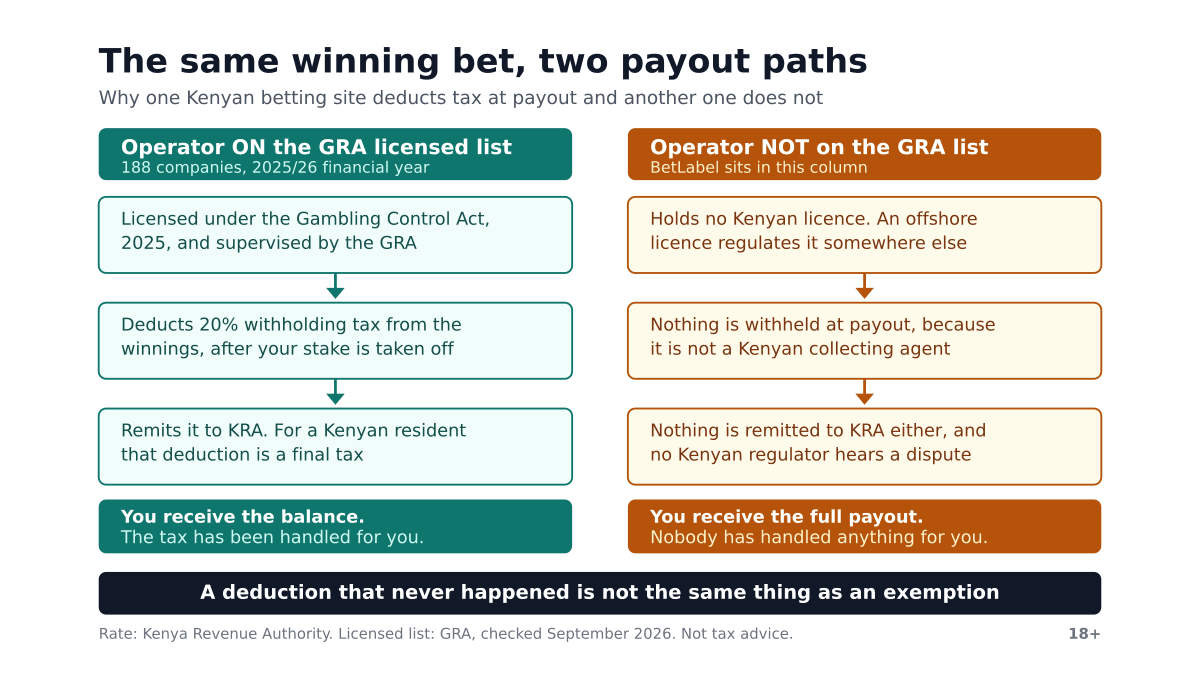
If you are asking which betting site has no tax in Kenya, you are almost certainly looking at a list of names, and not one of those names is exempt, which is what makes the list itself the thing worth checking. No operator can make a Kenyan winner exempt, so no list can honestly be sorted by exemption however it is headed. What you can do, in less time than it takes to read one of those pages, is work out who is making the claim, which of two very different things it means, and what you hand over if you act on it. This page is those three checks. If the number you came for is the rate itself, the betting tax page sets out what is charged and on what, with the arithmetic done in shillings, and this one does not.
Which betting site has no tax in Kenya? None, and the list itself is what to check
None of them, and the more useful thing to notice is who is answering the question, because the pages that rank for it are not in a position to grant what they are ranking. Search the phrase and what comes back is a row of affiliate lists sorting operators by exemption, which is not theirs to give. The phrase itself is doing two different jobs that are not the same. One job is describing an operator that deducts nothing from your payout. The other is describing money that Kenyan law never asks about. The list pages ranking for this query answer the first and let you walk away believing they answered the second, and the three checks below are how you tell which one you have been handed.
The deduction you are picturing is withholding tax, and it works the way withholding tax works everywhere: the person paying you takes it off and sends it to the revenue authority, so the money never passes through your hands. The Kenya Revenue Authority puts that rate at 20% on winnings from betting, gaming, prize competitions and gambling, and whether it ever reaches your payout turns on who is paying you rather than on what a review page says about it. How much is charged, on which part of the money and in what order is the betting tax page’s job; from here this page is about testing the claim.
Check one: look the operator up on the regulator’s own list
This is the shortest of the three and it settles more than the other two together. Search the operator’s name on the Gambling Regulatory Authority’s published list of licensed companies rather than on the site making the claim or the affiliate page recommending it. That list is the regulator’s own record, it is public, and a name is either on it or it is not. A badge, a seal or a confident sentence on a review page is somebody describing the record to you, which is not the same as the record.
The list says nothing about tax directly, and it does not need to. It tells you whether there is anyone inside Kenya who would deduct at all, which is the question actually sitting underneath a no tax claim.
Check two: is the page saying nothing is deducted, or that nothing is owed?
Read the claim slowly, because those are two different assertions and only one of them is ever true. “This site does not deduct” describes a process. “Your winnings are exempt” describes the law, and nothing in Kenyan law says it. The two are almost never supported by the same evidence, and a page that slides from the first to the second is doing it in the space of one sentence.
The wording of the law is where you can watch them come apart. In the statutory definition PwC’s Kenya tax summary records, “winnings” is a payout from a lottery or prize competition made by a person licensed under the Gambling Control Act, 2025. The wording ties the term to a licensed payer, and money reaching you from an operator holding no Kenyan licence sits outside it, which is precisely why no licensed Kenyan operator is deducting anything on your behalf. That describes who collects. It is not a published exemption, and your own position is a question for KRA or a qualified Kenyan tax adviser rather than something a betting site can settle for you.
That is the whole of the mechanism, and it is why the two columns in the diagram above end in different places. One reader receives a balance with the tax already handled. The other receives the full amount with nobody having handled anything for them, which is a difference in who was keeping the records and not a difference in what was owed.
Check three: price what the claim costs you
There is a cost sitting on the other side of that trade, and the list pages rarely price it. An operator outside the Kenyan licensing framework is also outside Kenyan dispute resolution. If a payout stalls, the Gambling Regulatory Authority has no jurisdiction to act on your complaint, and what you are left with is whatever the operator’s own process provides.
That is the part of the trade that only becomes visible once something has already gone wrong, which is why it belongs in the decision before a deposit rather than after one. Our guide to choosing a betting site in Kenya works through the checks that decide this, most of which matter more than a bonus figure.
What are the “tax free betting sites” list pages actually describing?
They are describing something real, but they are not describing an exemption. Work through the sites those pages name and most turn out to be offshore operators that Kenyan licensing does not reach. The observation underneath the page is accurate: nothing appears as a deduction on the payout. The conclusion drawn from it is where the page fails, because a deduction that never happened is not the same event as a liability that never existed.
Searches for how to avoid betting tax in Kenya land on those same pages, and what they turn up is a way around the deduction, which is not the same thing as a way around the charge. The pages do not draw that distinction, because drawing it would spoil the headline.
Heavy promotional framing is information in itself, and it is worth reading as part of check one. Gambling advertising in Kenya requires approval under the Gambling Control Act, 2025, and the 2026 licensing regulations analysed by CM Advocates put promotional campaigns under a separate authorisation on top of that. A page built to sell an outcome is working to a different standard than a page built to explain a rule.
Is BetLabel one of these sites?
Yes, and this site says so rather than working around it. BetLabel does not appear on the Gambling Regulatory Authority’s list of licensed companies, which carried 188 operators for the 2025/26 financial year when it was checked on 8 September 2026. The operator holds a Curacao licence, and a Curacao licence regulates it where it is registered, not here.
The tax consequence follows automatically, and it is not a selling point. Because BetLabel is not licensed in Kenya, it is not a Kenyan collecting agent, so no Kenyan withholding is applied to a payout it makes. The obligation to be straight with KRA about your own position stays with you, unmoved. The same missing licence is why whether BetLabel is legal in Kenya and how its withdrawals work are worth reading before a deposit rather than after one.
Does a tax change ever turn a claim like this into a true one?
No, and the obligation does not move when the rate does. Kenyan betting taxes have shifted in both directions over the past few years, in scope as well as in rate, and each time they shift a fresh crop of pages presents the movement as an opening. A change in how much is charged is not a change in whether anything is owed, so none of it produces a site where a Kenyan winner is exempt. Where the rates stand today, and how they got there, is the betting tax page’s job rather than this one’s.
A suggestion circulating in Kenyan search results describes a further overhaul charging a flat rate on every withdrawal. We could not confirm that against KRA or against the text of a Finance Act, so no figure for it appears on this page. A wrong percentage on a tax page is exactly the error a reader has no way to check and no reason to doubt, which is why the honest answer here is that it remains unverified.
Betting in Kenya is for adults of 18 and over, and for most people the tax question is a far smaller risk than the spending one. If the amount going into stakes has started to reach rent, fare or school fees, the responsible gambling page sets out the support available in Kenya and the practical steps that help.